ki-fuer-menschen · 2026-05-17
Wabi-Sabi and Indie Building — Why Polish is Poison in Solo Mode
TL;DR
Wabi-Sabi (侘寂) is the Japanese aesthetic principle that recognizes value in the imperfect, the grown, and the real. Translated to indie building: one idea, one repo, no polish (see the 424-repos post). Whoever waits for perfection ships five projects instead of fifty. Whoever builds for polish often signals the opposite of what they mean — solo indie with corporate gloss looks like prep for an acquihire, not honest work. This post shows: what Wabi-Sabi concretely means (beyond Instagram aesthetics), the 5 patterns it triggers in my work, and the 3 conditions under which it is counterproductive.
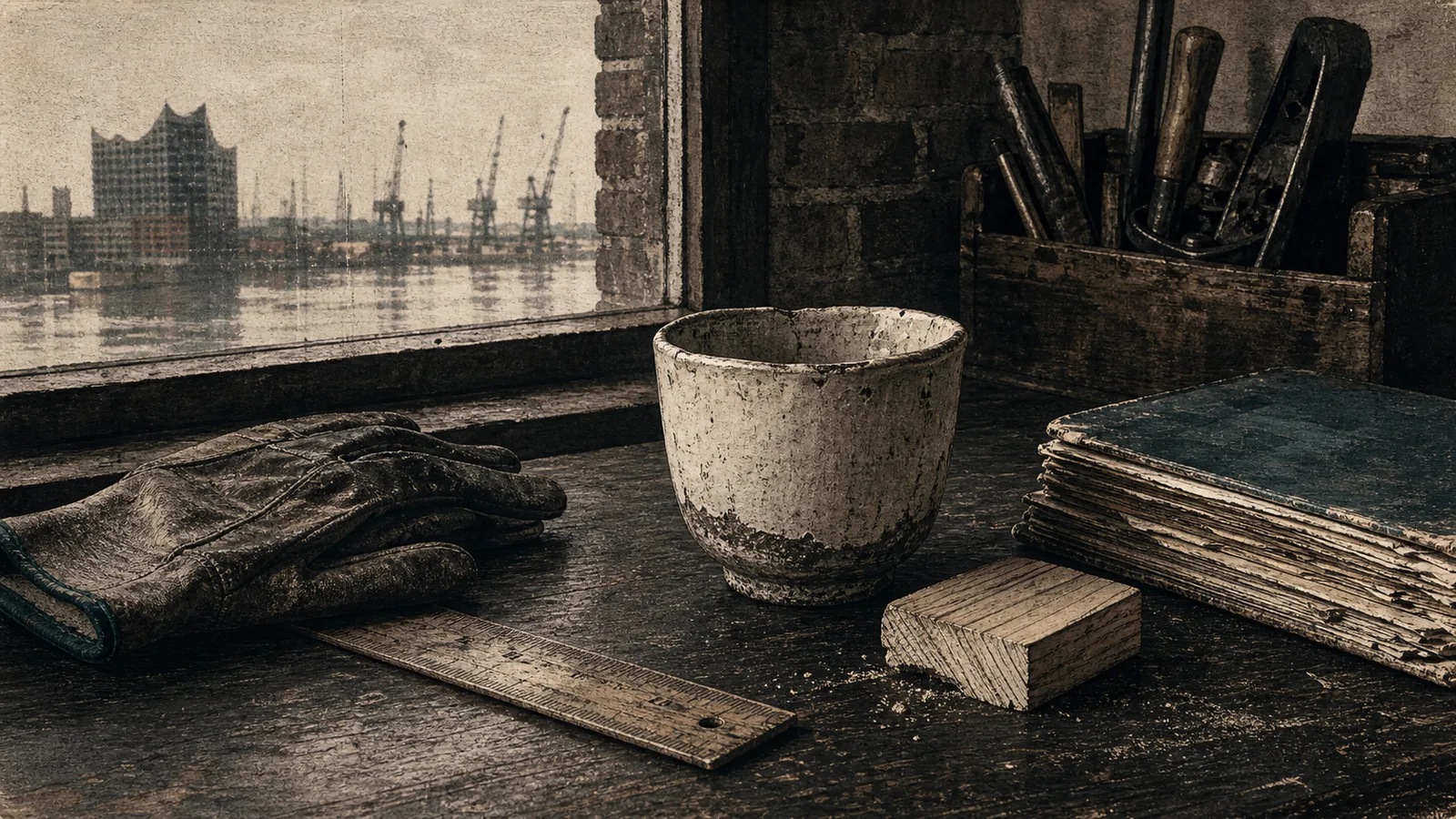 Featured: stylized tea bowl with visible repair, Kintsugi-adjacent. Wabi-Sabi says: the cracks make it valuable.
Table of Contents
- What Wabi-Sabi actually means
- Indie builder translation in 5 patterns
- Three failure modes I observe
- When Wabi-Sabi is counterproductive
- Three application rules
- What about this is northern German
- FAQ
What Wabi-Sabi actually means
Wabi-Sabi consists of two concepts:
- Wabi (侘) — originally solitude, today more a sense of rustic simplicity and unpretentiousness.
- Sabi (寂) — originally decay and transience, today more the beauty that arises through age and use.
The canonical Western source for the concept is Leonard Koren’s “Wabi-Sabi for Artists, Designers, Poets & Philosophers” (1994, revised 2008). Koren formulates three core ideas:
- Everything is impermanent. Nothing holds in its current state forever.
- Everything is imperfect. Nothing reaches true completeness.
- Everything is incomplete. Nothing is finally finished.
From this follows an aesthetic that values asymmetry, roughness, simplicity, modesty, intimacy, and natural processes — not rejecting them, but explicitly aesthetically valuable.
What Wabi-Sabi is NOT:
- The Instagram aesthetic of “rustic farmhouse” or “shabby chic” — that is Western adaptation, often commercialized
- An excuse for bad work (“it’s just Wabi-Sabi”)
- Anti-quality — Wabi-Sabi does not say “sloppy,” it says “honestly aged”
Indie builder translation in 5 patterns
Where the principle concretely shows up in my indie practice:
Pattern 1: README with life-marks instead of polish-doc
A good indie-project README shows: what it currently is (incl. a what-does-not-work section), what it was (changelog), and what it could still become (TODO/roadmap). Corporate docs hide the latter two behind version releases and vision statements. Indie docs show the cracks openly.
Concrete example: the Conductor project README explicitly says “repo is private” — no hiding. Says “v8.1.0 in production, v9 in planning with three open pains.” Says “works for me, may not fit you.”
Pattern 2: Sites with real photos instead of stock
This site uses three real, old photos of me (1972 school enrollment, 1986 graduation, 1995 party after the intermediate exam — see About). They are PNG originals from the 90s, slightly cropped, not retouched. That is Wabi-Sabi-compliant. Stockphoto-smooth would be the opposite — and would contradict the “30 years of software” narrative.
Pattern 3: Blog posts with numbers that do not posture
When I write “424 repositories,” 424 is not a trophy — it is the count at a given date, accompanied by the admission that 57 of those are archived and about half the living repos are pre-revenue. Wabi-Sabi writing includes the ugly details. Polish writing would only mention 424 + cut to stage.
Pattern 4: One-idea-one-repo method
The indie builder method with 424 repos is at its core wabi-sabi: accept that most ideas die. The repo is a throwaway container. It does not have to be pretty. It has to be fast. Speed + acceptance of decay = Wabi-Sabi in workflow form.
Pattern 5: Direct customer contact instead of CRM theater
In the Moinsen SME context Wabi-Sabi means: email, mobile phone, in-person meeting — not a 6-stage sales funnel. Customers who fit me appreciate the unpolished directness. The others do not fit.
Three failure modes I observe
In my direct indie-builder environment I see three Wabi-Sabi anti-patterns, all rooted in perfectionism pain:
Failure 1: “Do not launch yet, not finished”
Classic. The project has 80% of the value, but 20% polish is missing. Instead of launching, we polish another 4 months. By then a competitor has launched with 60% of the value — and won market position.
Wabi-Sabi fix: launch at 70%, polish via real user feedback. Pieter Levels’ “make a product in 12 hours” is the radical version of this principle.
Failure 2: Marketing site looks like a Series-A pitch
A solo indie with a site that looks like a 50-person SaaS company sends mixed signals. Looks professional, feels fake. I trust an untidy indie repo with an honest limitations section over a perfectly choreographed marketing site with a “trusted by Fortune 500” wall.
Wabi-Sabi fix: brand voice aligned with stack reality. Indie = personal + direct + honest. Confirmed by Pieter Levels’ low-polish sites and Tyler Tringas’ “Indie SaaS” writing — both successful despite (or because of) deliberately non-polished outward presentation.
Failure 3: Mock data instead of real stories
In demo calls, 90% of indie founder demos show sterile mock data — “Test User 1,” “Example Account.” Real stories from your own workflow convince 10× better. Patrick McKenzie’s “show your work” is the application of this idea.
Wabi-Sabi fix: show your own real repo, your own real CSV, your own real use case. Even when it looks imperfect. Especially then.
When Wabi-Sabi is counterproductive
Three conditions where the principle hurts:
1. YMYL domains (Your Money or Your Life)
Medicine, finance, legal, safety. Here polish deficit equals trust loss, which is expensive. An untidy UI in a health-tech app does not look charming, it looks alarming. Wabi-Sabi does not apply here.
2. Enterprise sales with audit obligation
Selling to corporations with compliance audit. Whoever wants to convince DAX-30 CIOs cannot run their site on “indie builder charm” — audit teams need process docs, test reports, SOC2 attestations. Wabi-Sabi on indie site OK; Wabi-Sabi in enterprise sales package is a deal killer.
3. Mass-consumer apps
Whoever builds an app for Millennials or Gen Z is fighting against Tinder, Instagram, Notion UI standards. Wabi-Sabi roughness here does not feel charming, it feels technically backward. B2B indie yes, B2C mass no.
Three application rules
If you want to test Wabi-Sabi in your own indie workflow:
Rule 1: Ship at 70%, polish via feedback
Define a “70% would be enough” line before launch. When the project crosses that line, launch. Polish comes from real user feedback, not your head.
Rule 2: Write the limitations statement first
Before writing the marketing material: explicitly write down what the project cannot do. 5-10 sentences. If you cannot answer those sentences honestly, you do not know your project well enough yet.
Rule 3: Show your real setup
Instead of stockphotos: show your real repo (even the messy one), your real CSV file, your real setup. Even if it is not pretty. Authenticity beats polish in the indie world by a wide margin.
What about this is northern German
The surprising thing about Wabi-Sabi for me: at its core it is Hanseatic.
- Nicht schnacken, nicht blenden, nicht künstlich aufblasen (do not chat, do not dazzle, do not inflate) — directly Wabi.
- Geh raus auf’n Deich, der Wind richtet’s (go out to the dike, the wind sets it right) — Sabi with weather.
- Substanz schlägt Show (substance beats show) — the central Wabi-Sabi thesis in two words.
The Japanese language captured it more precisely. But northern German practice has lived it for centuries. Maybe that is why the Wabi-Sabi connection in Hamburg + Schleswig + the Hamburg metro area (where many indie builders sit) is so natural.
Where this goes next
My next planned Wabi-Sabi step: make the Conductor repo public. Not polished, not softened — as it is. 24 months of grown code with a cracks-and-gold-seams history. Planned for summer 2026, after the v9 release.
If you struggle with Wabi-Sabi in practice (or apply it actively and have results): reach me on LinkedIn. I am curious what works in the Western indie environment and what does not.
FAQ
Is Wabi-Sabi only an aesthetic or also a method?
Both, but for indie builders the method matters more than the aesthetic. The method: accept imperfection as a feature, not a bug. Optimize for speed + honesty over polish + completeness.
Where is the line between Wabi-Sabi and “just sloppy”?
In the intent. Wabi-Sabi says: “It is imperfect because I deliberately skip certain polish to show more honest substance.” Sloppy says: “It is imperfect because I could not or did not want to do better.” The first stance stands behind the work; the second hides.
Does Wabi-Sabi marketing actually work?
Empirically yes for B2B indie — see Pieter Levels’ nomadlist.com as an example site with deliberately non-polished UI, yet millions in revenue. For B2C mass rather no, polish wins there.
Which book do you recommend?
Leonard Koren: “Wabi-Sabi for Artists, Designers, Poets & Philosophers” (1994/2008) — short, precise, canonical. Avoid Instagram-coffee-table books that turn the concept into a lifestyle brand.
Is Wabi-Sabi compatible with modern UX design?
Partially. UX best practices (usability, accessibility, clear CTAs) are non-negotiable — Wabi-Sabi does not justify bad UX. But visual polish (pixel-perfect alignment, glassmorphism, AI-generated hero sections) can be Wabi-Sabi-rejected. Keep function, drop polish.
Written on May 17, 2026 in Hamburg. This post itself is not polished — it has repetitions, transitional roughness, and no generated closing image. That is intentional. If you find this post useful, link to it.